 fter World War I, the small Island of Rhodes was taken from its Turkish occupation of four hundred years and handed to Italy. At that time the Jewish population of the Island, all Sephardic Jews, numbered over five thousand and had lived in harmony with the Turks on the Island. Gradually the new Italian authorities started to impose selective controls and restrictions on movement, travel, and businesses on the Jewish community. fter World War I, the small Island of Rhodes was taken from its Turkish occupation of four hundred years and handed to Italy. At that time the Jewish population of the Island, all Sephardic Jews, numbered over five thousand and had lived in harmony with the Turks on the Island. Gradually the new Italian authorities started to impose selective controls and restrictions on movement, travel, and businesses on the Jewish community.
When Mussolini came to power, one of his first acts was to order that the ancient Jewish cemetery, which was just outside the fortified walls of the Old City, had be removed. Relatives who could afford to move the remains of their families were able to do move them to the new cemetery outside the city, but the graves of the others remained under what became a park and open air auditorium. The remaining tombstones were removed and the marble was used to decorate the lavish mountain holiday villa Mussolini built for himself. This started an exodus of the younger members of the community to many parts of the world looking for a better, freer life. From Rhodes they emigrated to the mainly United States, Argentina, the Belgian Congo and to Southern Rhodesia (now Zimbabwe) where my parents and I went. By the start of World War II only seventeen hundred remained.
In December of 1938, my father, who was a well known and wealthy merchant, was advised by a very highly placed Italian friend to leave as soon as possible. Leave everything and pretend he was going on vacation with his family. This we did, leaving everything we possessed but for what we could take with us, being careful not to raise suspicion. Taking out jewelry, gold or undeclared currency was punishable by death at that time.
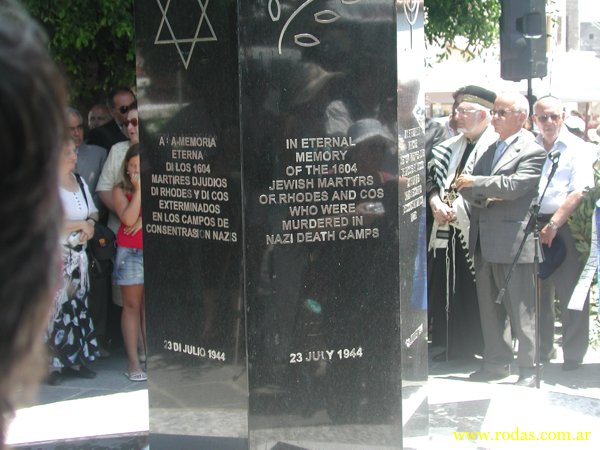
All who stayed in Rhodes, except for two families who were Turkish nationals and thus protected by the Turkish consul, were rounded up on July 23, 1944, stripped of all gold and jewelry, and deported. Sixteen hundred and four older deportees and all the younger children perished at Auschwitz, only a few, who had been used as slave labor, survived the remaining 10 months of the war.
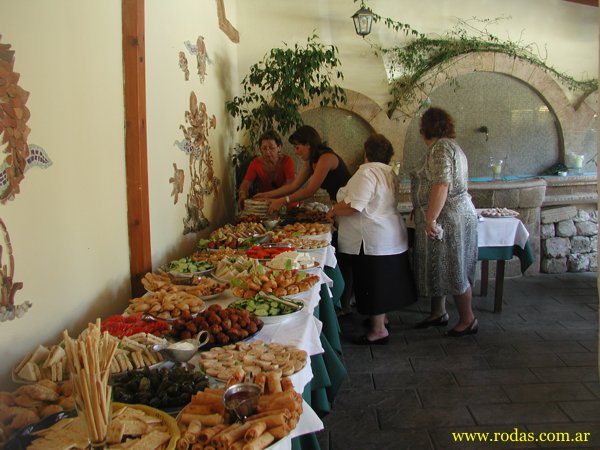
This year, sixty-three years after the deportation, I attended a commemoration held in Rhodes. It was attended by just six survivors, a few, like myself, who left Rhodes before the war and many, many descendents who were looking for their roots. Over four hundred of us attended the well organized week of concerts, tours and luncheons, one of which was hosted by the City of Rhodes. All of the luncheons were catered by the week’s organizers and it was great to feast on the delicacies that we were all used to since childhood. It added so much to the nostalgia we all felt.
The main events were naturally the commemoration services held at the cemetery, at the ancient synagogue and at the memorial to those who perished.
The memorial service at the Jewish cemetery was more of a private affair for the descendents of those buried there since 16th century. It was a strange feeling. It felt more like paying homage and praise to our forefathers for the tribulations they had endured over the centuries rather than mourning their passing.
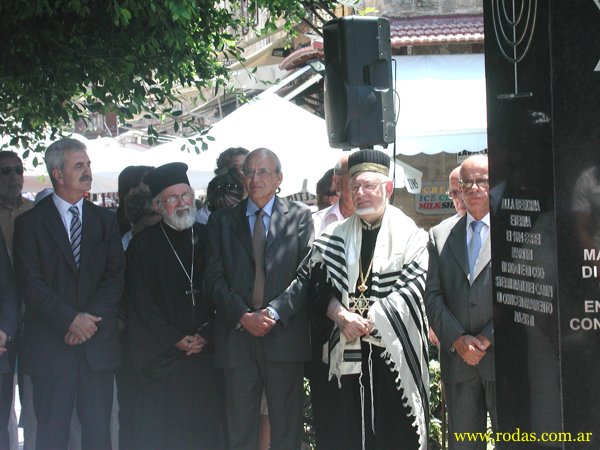
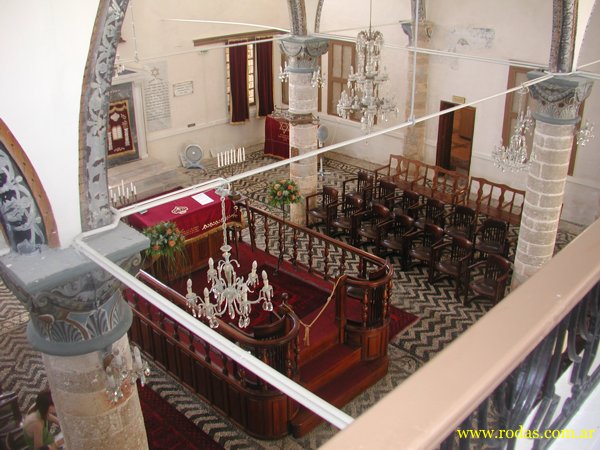
The main ceremony was held in the ancient synagogue. Built in 1572, it is the second most continuous used synagogue in the world and is registered as a world heritage site. It is the only one of left of the original nine synagogues on the island. All the others were bombed out during the war or converted to other houses of worship. The service was attended by dignitaries from the Island, including the Patriarch of the Greek Orthodox Church, the Mayor of the City of Rhodes and the island’s Greek Governor. The Chief Rabbi of Greece traveled from Athens, to conduct the service. There were several speakers and by the end there was not a dry eye in the assembly as the horrors of what the Nazis did to some of the congregation before the deportation were recounted.
At the end of the service we walked to the “Square of the Hebrew Martyrs” where a memorial had been erected a few years ago. Here we had a short ceremony with a very touching poem was recited by a Jewish poet from France. The city’s brass band played the Greek and Israeli anthems.
The entire week was a great opportunity to renew old acquaintances, some of whom I had not seen in almost half a century, and to meet relations I never knew I had! I met a childhood playmate who lived next door to us in Rhodes – last seen in 1938 when I was just a toddler. I was discussing engineering with a distant relative from Cape Town, about my age. He had been a consulting mechanical engineer in South Africa and had worked on the design of the opera house project in Pretoria, the largest project there at that time. As a consulting structural engineer, I had designed of the entire structure, yet we had never met prior to this meeting in Rhodes. This meeting brought to light the extent to which the Rhodes community had spread, grown and made their mark around the world.
On another occasion, on one of the tours, a burly man, in his early fifties, was sitting in front of me, speaking in a Rhodesian accent. I asked his name. It was Raymond. It immediately rang a bell. I was able to tell him the names of his father, mother and two brothers. He was very surprised and asked how I knew, so I reminded him that he had been a page boy when my wife and I were married in 1961!
By the end of the week we all had a deeper understanding of the meaning of family – we were all family, not just friends – and a high respect of what our forefathers on the island had to live through. There were tears, there was laughter and there were many surprises. Most important of all, an invisible bond was built up, not only between all who attended, but also between us and those who had passed on before us.
Sol Menashe
Pictures by Sol Menashe
Back to Articles |
